
What the city's own page says about your water
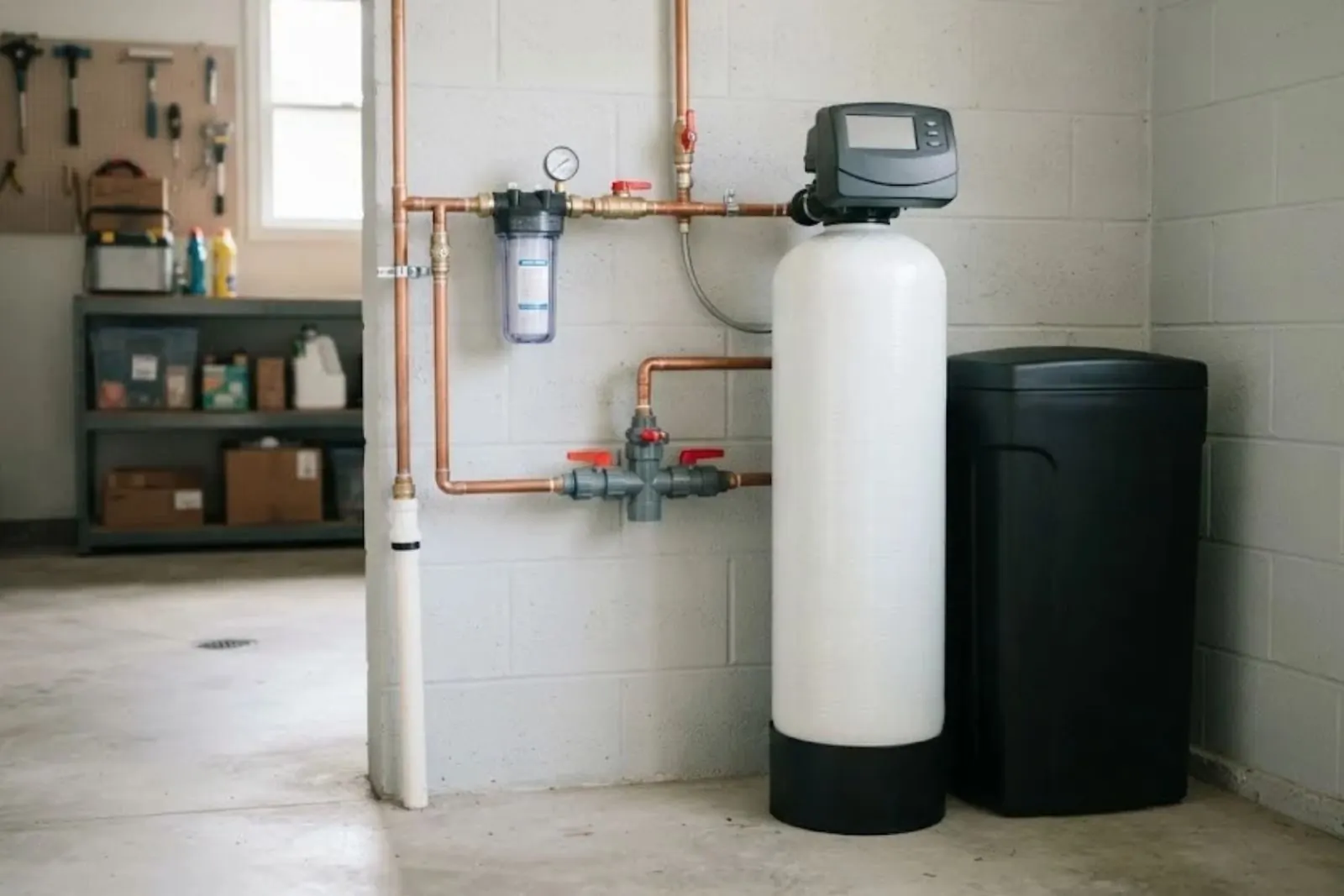
A water softener is a treatment tank that removes hardness minerals, mostly calcium and magnesium, from the water entering your home. Brigham City's water page states hardness of 17 to 20 grains per gallon, and the USGS scale calls anything over 10.5 very hard. By that yardstick, the city's water sits well inside the very hard band.
The city draws from 17 sources in its 2025 report, 8 springs and 9 wells, so the figure can drift a little by season and by tap. Ask Public Works for the current number before you size a unit, because the number sets how often the softener must regenerate.
What very hard water leaves behind at home
Spotted glasses and fixtures
White film dries on glass, chrome and shower doors no matter how often you wipe.
Clogged aerators and showerheads
Chalky crust narrows the holes, so flow weakens and sprays veer sideways.
Worn faucet cartridges
Grit scratches ceramic discs and rubber seals, which leads to drips.
Dull laundry and dry skin
Soap reacts with minerals, so you use more of it and rinse less cleanly.
Scaled appliances
Dishwashers, ice makers and coffee machines collect crust that shortens their lives.
The hardest-working appliance is the heater. Scale insulates the elements and the burner floor, which is why our water heater repair crews see so many scale failures, and why a tankless water heater depends on treated water to keep its exchanger open.
Softener, conditioner, filter or reverse osmosis: which does what
| Device | What it does | What it does not do |
|---|---|---|
| Salt-based softener | Removes hardness through ion exchange | Does not filter sediment, chlorine or taste. |
| Salt-free conditioner | Changes how minerals stick to surfaces | Does not remove hardness minerals from the water. |
| Whole-house carbon filter | Reduces chlorine taste and odor | Does not soften. |
| Under-sink reverse osmosis | Treats drinking and cooking water at one tap | Does not protect pipes or appliances. |
| Sediment filter | Catches grit and rust particles | Does not touch dissolved minerals. |
Brigham City's chlorine residual averages 0.44 ppm, and lead is reported as non-detect in the 2025 report. If taste is your complaint, add a carbon filter. If scale is the complaint, the softener is the tool.
Spots on the glass again?
Describe your fixtures and we will talk through the options.
Where a softener goes and how it is installed
- Choose the spot
Near the main water entry, with a drain nearby, a power outlet and room for a salt tank.
- Add a bypass
A bypass valve lets you isolate the unit for service without shutting off the house.
- Plumb in and out
Hard water goes in, soft water comes out, and outdoor spigots can stay on hard water if you prefer.
- Run the drain and brine line
The regeneration cycle needs a legal drain connection and an air gap.
- Program and test
We set hardness, capacity and cycle time, then regenerate and test.
Softener installs touch the supply and drain, so plumbing installation standards apply. Permit rules vary, so ask the Brigham City building office at (435) 734-6604 before starting.
Repairing or reinstalling an existing unit
Many calls are about a unit that already exists: a broken control valve after a move, a cut regeneration line during a remodel, a mushed salt tank or a unit that has stopped regenerating. We look at the valve, the injector, the brine line and the drain.
Some brands need specific parts or software. Tell dispatch the model on the label, and we will say honestly whether it is something we can service or whether swapping the head is the better value.
Wells, private supplies and drinking-water add-ons
Homes on a private well need a water test first, because iron, sulfur and sediment change what treatment is required. A softener does not cure every well-water problem. Ask a certified lab to test before spending money.
For drinking water only, an under-sink reverse osmosis system at the kitchen tap is a smaller project. It is not a substitute for protecting pipes and heaters, but it does handle taste.
Salt, upkeep and what to expect month to month
A salt-based unit needs salt added every few weeks, depending on use. Water feels slippery, soap lathers well and spots fade within a week or two. Check the brine tank for bridging, a hard crust that stops salt from dissolving.
Plan on a yearly look at the valve and resin. If water suddenly feels hard again, the usual causes are empty salt, a clogged injector or a stuck valve. A dripping valve or a leaking tank is a plumbing call, and dispatch is 24/7 for that. Fixture wear that comes from long exposure may be fixed with a faucet repair visit.
What shapes the price of a softener job
Capacity
A bigger household with very hard water needs a bigger resin bed.
Location and plumbing changes
Reaching the main line and the drain takes more or less work.
New unit or service
Installing a purchased unit costs less than a full system.
Extras
Filters, bypass lines and RO stages add parts.
Access
Basement, garage and closet installs differ.
Insurance does not usually pay for water treatment. Want your real number? Call (855) 575-2890 and you get a clear price before work starts.
Tremonton and the rest of the county
We install from our shop at 647 S Main St in Brigham City, and Tremonton service is about 20 miles away. Tremonton and other towns run their own utilities, so ask yours for its latest water quality report before sizing a unit. Brigham City's number does not apply there, and a wrong assumption costs you a unit that is too big or too small.
Frequently Asked Questions
The city's water page lists 17 to 20 grains per gallon. Ask Public Works for the current figure, since it sets the softener size.
Yes, in many cases. Tell us the model and we will check the connections, drain and bypass needed.
Often. Valve replacement, injector cleaning and drain repairs are common. Some brand-specific parts may not be available.
Usually not. The sodium added is small, but people on a low-sodium diet should ask their doctor.
Most owners leave outdoor taps on hard water to save salt. We can set this up either way.
Yes, an under-sink unit is a smaller project that treats one tap. It does not protect pipes or appliances.
Sources and standards
- Plumbing codes in the UPC and IPC families set the rules for fixtures, venting and drains. Ask the Brigham City building office at (435) 734-6604 which edition and permit rules apply to your job.
- The Utah Division of Professional Licensing offers a public Verify a License tool for checking any plumber's license class.
- The Brigham City Water Division explains hardness, pressure testing and water quality on its water page. Call Public Works at (435) 734-6615 with questions.
- Enbridge Gas Utah says to leave the building first if you smell gas, then call 911 or its 24-hour emergency line from outside.
Written by Brigham City Pro Plumbing. Last updated October 29, 2026.