
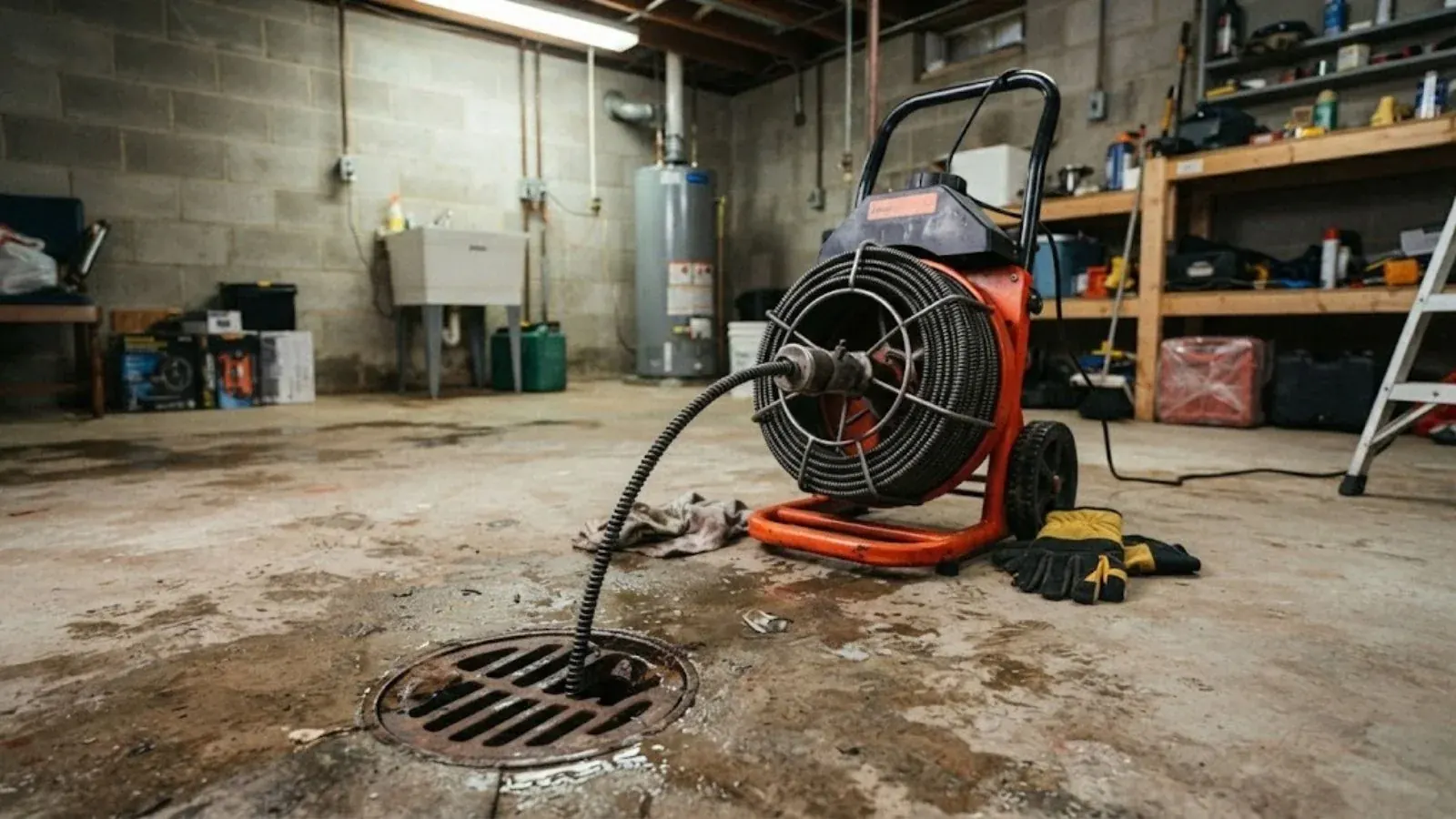
Water backing up in your house right now
A drain that spits water back up is an emergency in the making, and our licensed plumbers answer the phone 24/7 for it. While you wait, stop sending water down that line, pull rugs and cardboard off the floor, and keep the chemical drain opener on the shelf, because mixed chemicals give off dangerous fumes.
Drain cleaning in Brigham City means removing the blockage from a fixture drain or branch line so water flows again, using a hand auger, a power cable or a camera to see what is stuck. Grease, hair, soap film and wipes cause most of it.
- Turn off the washer and dishwasher if they share the clogged line.
- Do not plunge a toilet and a tub on the same line, because pressure pushes water out the weakest opening.
- Move anything valuable away from floor drains and baseboards.
- Tell us which fixtures are slow, which gurgle and which are fully stopped. That pattern shows us where to start.
How a clogged drain announces itself
Callers describe the same handful of things. The kitchen sink drains slowly, then not at all. The tub fills while the shower runs. The washer drain gurgles or spits at the standpipe. A toilet flushes weakly and the shower drain bubbles at the same moment.
Two signs deserve extra attention. A sewer-gas smell in a bathroom, or water showing up at the baseboards or a basement floor drain, usually means the blockage is deeper than a single fixture. If several drains act up together, the stoppage sits on a shared line, and a quick fixture-level fix will not hold.
Kitchen sink clogs: grease, food scraps and a shared line
Kitchen drains clog differently from bathroom drains. Cooking fat cools inside the pipe and coats the wall, and each rinse leaves a thin new layer. Over months the opening shrinks to a slot, and a lump of rice or coffee grounds finishes the job.
A sink that backs up into the laundry sink or dishwasher tells us the blockage is past the trap, not in it. We open the trap first to rule out a simple jam, then run a cable down the wall line. If a disposal sits in the line, we check that it is not the culprit. Our disposal repair page covers the jams and leaks that mimic a clog.
A wet cabinet floor is a separate issue. A loose slip nut or cracked trap causes it, and we check joints before cabling because a cable can loosen a weak fitting.
Standing water in the sink or tub?
Stop running water and call. We dispatch around the clock.
What snaking and cabling actually do inside the pipe
- Find the access point
We use the trap, a cleanout or a removed fixture. The closest opening to the clog saves the most cable.
- Feed the cable
A spinning head runs down the line until it meets resistance. The feel of the stop tells us if it is soft (grease), stringy (hair) or hard (a foreign object).
- Break or hook the blockage
The head cuts a hole through the clog or pulls it back out. Pulling out beats pushing through, since pushed debris settles again downstream.
- Flush and test
We run hot water and then a heavy flow to see whether the drain keeps up under real use.
- Camera if needed
If the clog returns, a camera shows whether the pipe is scarred, sagging or invaded by roots.
A cable has limits. A short cable fails on a long run, and a thin cable pokes a hole in a grease wall that can close again. A cable also cannot clean the pipe wall the way water can, which is why repeat clogs often call for hydro jetting after the first clearing.
Tub, shower and washer drains
Tub and shower drains clog with hair and soap scum, usually in the first few inches below the strainer or in the trap. If the water stands after you pull the stopper, we remove the strainer, pull what we can reach and cable the rest.
Washer drains clog on lint and detergent residue. The standpipe fills, then overflows onto the laundry floor in the middle of a cycle. A cable from the standpipe usually clears it, and a lint filter on the washer hose helps keep it clear.
A drain line leak behind a wall or under a floor looks like a clog at first: slow water, damp drywall, a musty odor. If the line is cracked, cleaning it only moves water to the leak faster. That is when a camera earns its keep, and when a repair, not a cleaning, is the right answer.
Which tool fits which clog
| Situation | Usual first tool | Why |
|---|---|---|
| Single sink or tub, slow or stopped | Hand auger or short cable | Short run, easy access, quick to confirm. |
| Several fixtures slow on one branch | Power cable from the nearest cleanout | Reaches the shared line past the branch. |
| Grease coating a kitchen line | Cable, then jetting if it returns | A cable opens a hole and jetting scours the wall. |
| Clog returns every few months | Camera, then jetting or repair | Something in the pipe keeps catching debris. |
| Water at a basement floor drain | Cable from the floor drain or cleanout | Floor drains connect to the lowest part of the system. |
What moves the price of a drain job
Where the clog sits
A trap at the sink is quick. A blockage deep in a branch line takes longer and more cable.
Access
A cleanout makes the job faster. Without one we may need to pull a fixture or work through a roof vent.
Cause
Hair and grease clear easily. Roots, a toy or a collapsed section change the plan.
Method
Hand auger, power cable, jetting and camera work are separate steps with different time needs.
Hour of the call
After-hours visits can be priced differently, and you hear the price before work starts. You hear the price before we start.
Homeowners policies often cover sudden accidental water damage, but they rarely pay for the wear, neglect or the blocked drain itself. Read your policy or ask your agent before assuming either way. Want your real number? Call (855) 575-2890 and describe what you see, and you get a clear price before work starts.
When it is bigger than a drain
Some stoppages are not a fixture problem. If sewage comes up in the lowest tub or floor drain whenever the washer runs, the main sewer line is likely blocked, and our sewer line cleaning page explains how that job differs. If the clog keeps returning and a cable finds nothing, a camera inspection shows what the pipe is hiding.
Some calls are not ours at all. If you smell gas, leave the building first, then call 911 or the gas utility. If water has reached outlets or appliances, shut off power to that area at the panel only if the panel is dry, and call an electrician. A condensate line from an air conditioner belongs to an HVAC tech.
Brigham City: your line, the city main and nearby towns
Your drain lines end at the property line, and the public sewer main starts there. If the city main might be involved, call Brigham City Public Works at (435) 734-6615 before assuming the fault is on your side. That one call can save a plumber visit when the blockage sits in the street.
We take drain calls across Brigham City and in nearby towns, including Perry, about 4 miles south. Same-day appointments are available when the schedule allows, and the emergency line stays open nights and weekends.
Frequently Asked Questions
Yes. The line is staffed 24/7, including nights and holidays. Overflowing sinks, sewage in a tub and a flooded floor drain all get urgent treatment, and same-day appointments are offered when the schedule allows. Tell us what is happening and what you have already tried.
We advise against it. These products can sit in a fully blocked pipe, splash during cabling and harm older fixtures. Plain hot water and a plunger on a single fixture are the safest steps while you wait.
Usually cooking fat has coated the pipe wall, so each cabling only opens a narrow channel. A scouring method such as jetting, or a change in what goes down the sink, ends the cycle.
Yes. We cable from the floor drain or a nearby cleanout. If the drain backs up whenever other fixtures are used, the main line may be the real problem, and we will say so.
If only one or two fixtures are slow, it is almost always on your side. If every drain is slow and a neighbor has the same trouble, ask Public Works at (435) 734-6615 about the main. We can also camera your line to show where the blockage begins.
A properly sized cable in sound pipe rarely causes damage. Old, scaled or cracked pipe is different, because a spinning head can catch an edge. That is one reason we feel the cable before pushing, and use a camera when the line looks fragile.
Sources and standards
- Plumbing codes in the UPC and IPC families set the rules for fixtures, venting and drains. Ask the Brigham City building office at (435) 734-6604 which edition and permit rules apply to your job.
- The Utah Division of Professional Licensing offers a public Verify a License tool for checking any plumber's license class.
Written by Brigham City Pro Plumbing. Last updated October 29, 2026.