
Water loss you cannot see, happening right now
Leak detection is the work of locating a hidden water loss so the repair can be small and exact. If water is spreading or your meter will not stop, Brigham City Pro Plumbing answers 24/7, and same-day visits are available when the schedule allows. While you wait, close the main shutoff, switch off power to any wet room, and lift rugs and boxes off the floor.
Photograph the stain or the soggy ground, and write down when you first noticed it. It also helps to know whether the problem changes after a shower, a laundry load or a sprinkler cycle. Those small details can cut the search time in half.
How the search works, tool by tool
Guessing is how people end up with four holes in a wall and the leak still running. A proper search moves from broad to narrow, and each step rules out part of the system.
- Talk it through
We ask where the water showed up, when it started and what changed. Then we check fixtures, shutoff valves, the water heater and low spots.
- Pressure test the lines
With every fixture closed, we hold pressure on the supply and watch a gauge. A falling needle confirms a leak, and closing off sections shows whether it is hot side, cold side or the yard line.
- Listen for the hiss
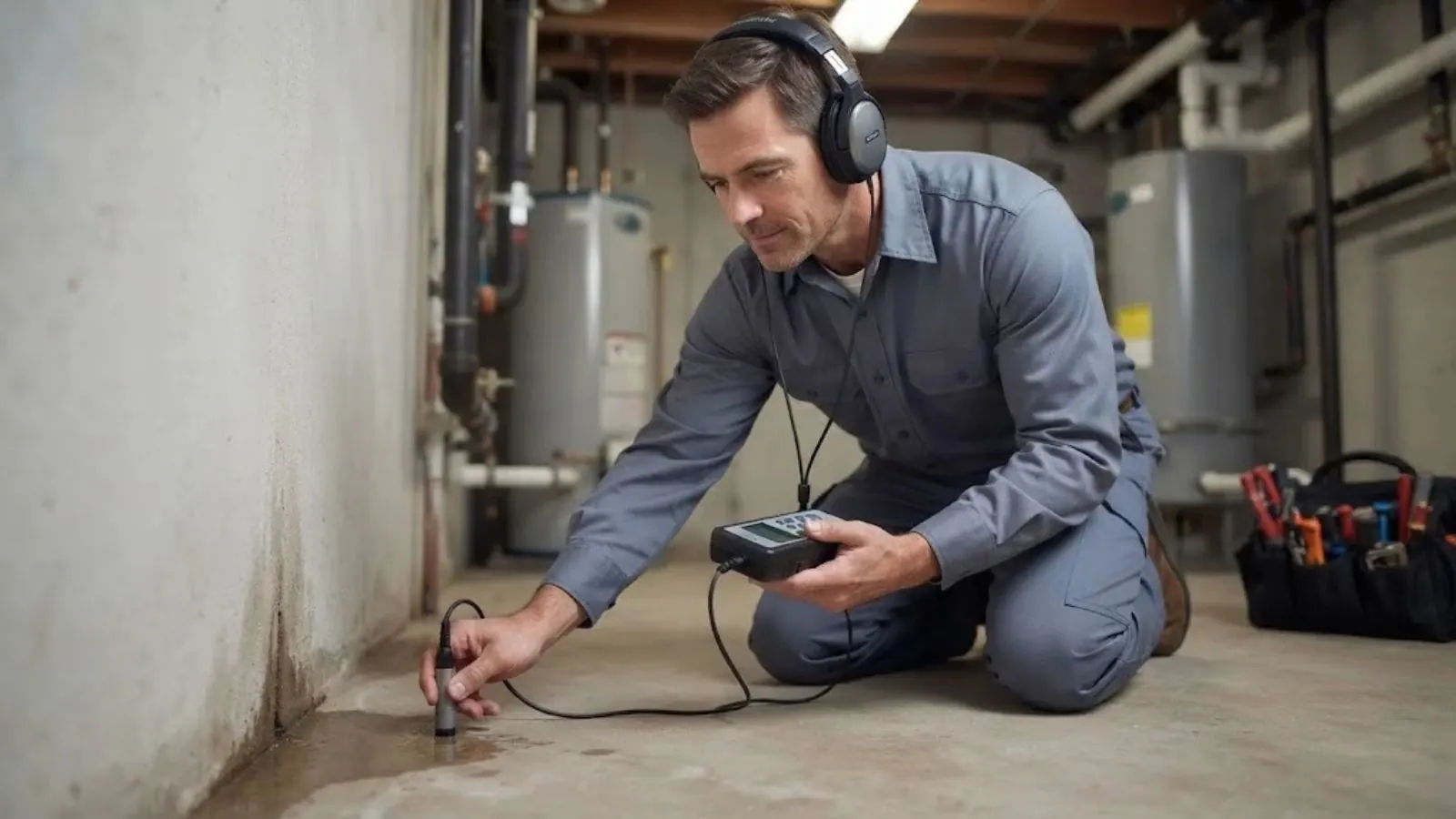
Acoustic microphones pick up the sound of pressurized water through drywall, concrete and soil. The loudest point is usually within a short distance of the break.
- Scan for moisture and heat
A moisture meter and a thermal camera show damp or warm zones behind finishes, which helps when a hot line runs under flooring.
- Camera the drains
If the water is coming from a waste line instead of a supply line, a drain camera shows cracks, offsets and root intrusion.
- Mark it and explain it
We mark the spot, explain the repair options and tell you how much opening is needed before any cutting starts.
| What you notice | Tool that usually finds it | Opening needed |
|---|---|---|
| Meter creeps with everything off | Pressure test, then listening | Often none until the spot is marked. |
| Brown ring or sag on a ceiling | Moisture meter and thermal scan | A small access cut at the source. |
| Damp wall or bubbling paint | Moisture meter, then pressure test | One patch-size opening. |
| Warm or wet floor | Thermal scan and floor microphone | Depends on whether the pipe is under concrete. |
| Soggy patch in the lawn | Ground microphone and line locate | Trench along the marked spot. |
| Sewer smell with a damp spot | Drain camera | Often none until the break is found. |
Meter spinning, or a bill that jumped
A meter that creeps forward while every tap, toilet and appliance is off means water is leaving somewhere. Residents are not permitted to open the city's meters, so leave the lid alone. Call Brigham City Public Works at (435) 734-6615 and ask about the city's water pressure testing, because a bad reading on the street side changes where we look first.
A bill that climbs with no change in habits is the other common trigger. Before you book, rule out a running toilet (drop a dye tablet in each tank and wait twenty minutes), a dripping hose bib and a sprinkler valve stuck open. If none of those explain it, the loss is probably inside a wall, under a floor or in the yard.
Meter still moving with everything off?
Close the main, then call for a pressure test and a pinpoint.
A stain on the ceiling or a damp wall
A ceiling stain that grows after someone showers upstairs usually points to a supply joint, a tub overflow gasket or a shower valve. A stain that grows only during rain points to the roof, which belongs to a roofer. Trace the edge in pencil, add the date, and look again the next day.
If the ring keeps widening on a dry day, shut off the water to that bathroom. Sagging drywall holds a surprising amount of water, so poke a small hole near the lowest point and let it drain into a bucket before the panel lets go. We keep the opening to the size of a patch whenever the readings allow.
Running water sounds under the house
A trickle under the floor, a musty smell at the crawlspace hatch or a sewer odor in a closet all deserve a look. Crawlspaces are the easiest place to confirm a leak because the pipes are exposed, so the search is usually fast. Sagging pipe, a failed heat tape wrap or a cracked drain joint are the usual findings.
- Shut off the main and listen again: silence means the sound was supply water.
- Keep the hatch clear so the technician can crawl straight in.
- Note any area where the insulation looks dark or sagging.
- If the ground under the house is wet even with the water off, groundwater may be the cause, and basement waterproofing is the better conversation.
Wet lawn, dense weeds and buried lines
A swampy strip of lawn, weeds growing thicker along one line or a sudden drop in pressure all suggest a break in the buried line between the meter and the house. Detection can mark the likely pipe path from above ground, so the trench is short when digging does start.
Utah's Blue Stakes asks you to call 811 at least 3 business days, and no more than 14 calendar days, before any excavation. Repairing a buried line means digging, so make that call early and let the utility marks go down. Skip the shovel, because a spade through a gas or power line is a worse day than a wet lawn. Ask Public Works where the city's side of the line ends and yours begins.
Warm floors and slab leaks
A floor that feels warm in one spot, carpet that is damp along an edge or a water heater that seems to run all day can mean a hot line is leaking under the concrete. A slab leak is slow and quiet, but it wastes water around the clock.
There are two honest ways to fix one. We can open the slab at the marked spot and fix the pipe, which means concrete work. Or we can reroute the line overhead, which spares the slab but takes more labor. If the pipe in your house keeps failing in new places, the repiping conversation is worth having. A heater that cycles constantly is also worth checking, and our water heater repair crew can rule it out.
Sprinklers, spas and the meter box
Irrigation leaks hide well because valves, risers and buried lateral lines all look alike once the grass fills in. A zone that runs weakly, a valve that never fully shuts or a lockout notice about backflow gives us a place to begin. We test the zone's pressure, then trace the line.
A hot tub that loses water, or a plumbed spa that drops overnight, needs its supply and return lines tested separately from the shell. We cover the plumbing side. A cracked shell is a spa builder's job.
If the meter box lid is wet or full of water, do not open it. Report it to Public Works so the city can decide whether the leak is on its side.
What changes the cost of a leak search
How many zones to isolate
A single-story house with one bath is quicker to section off than a split-level with three.
Access
An open crawlspace is easier than finished walls, and finished walls are easier than a slab.
Type of line
Hot, cold, drain, irrigation and buried service lines each call for a slightly different method.
Depth and surface
Soil, concrete and landscaping change how much listening and locating is required.
Timing and follow-up repair
After-hours calls differ from scheduled visits, and finding the leak and fixing it in the same visit can change the plan.
Homeowners policies often cover sudden, accidental water damage but usually not wear, neglect or the failed pipe itself, so check your policy and call your insurer before repairs if damage is large. Want your real number? Call (855) 575-2890 and you get a clear price before work starts.
Where we stop, and who to call instead
- Smell gas? Leave the building first, then call 911 or the gas utility from a safe distance. Do not flip switches or hunt for the source.
- Water near outlets or a breaker panel: stay clear and call an electrician after the power is off.
- A pipe that has already burst and is gushing is a burst pipe repair job, so close the main and call right away.
- Water coming through the foundation after snowmelt or a storm is a drainage question, not a pipe leak.
- Mold, soaked insulation and ruined drywall need a restoration company once the leak stops.
Our crews cover the whole of Brigham City, and plumbers serving Perry reach that town, about 4 miles south, in roughly 8 minutes. If the meter is spinning or the lawn is turning to mud, call at any hour, because the water keeps running whether the office is open or not.
Frequently Asked Questions
Yes. Dispatch runs 24/7, and same-day visits are available when the schedule allows. Shut off the main, turn off power to wet areas and keep the area clear until the plumber arrives.
We shut off the main and see whether the dampness keeps growing. If it does, the source is likely groundwater or a drainage issue. If it stops, the supply line is the culprit.
In most cases the cutting happens after the leak is located, not before. Pressure tests, listening gear and thermal scans narrow the spot first, so any opening is small.
Start with a quick check for running toilets and stuck sprinkler valves. Then call Brigham City Public Works at (435) 734-6615 to discuss the meter, since residents may not open it. If the loss is on your side of the meter, call us.
Usually yes. We explain the repair options, the opening needed and the clear price before any work begins. If the fix involves a different trade, we say so.
Policies differ. Many cover sudden, accidental water damage but not wear or the failed part itself. Ask your insurer before the work and keep photos of the damage.
Yes, Willard is about 7 miles away and Tremonton about 20 miles. Call (855) 575-2890 and give the address so dispatch can plan the route.
Sources and standards
- Plumbing codes in the UPC and IPC families set the rules for fixtures, venting and drains. Ask the Brigham City building office at (435) 734-6604 which edition and permit rules apply to your job.
- The Utah Division of Professional Licensing offers a public Verify a License tool for checking any plumber's license class.
- The Brigham City Water Division explains hardness, pressure testing and water quality on its water page. Call Public Works at (435) 734-6615 with questions.
Written by Brigham City Pro Plumbing. Last updated October 29, 2026.