
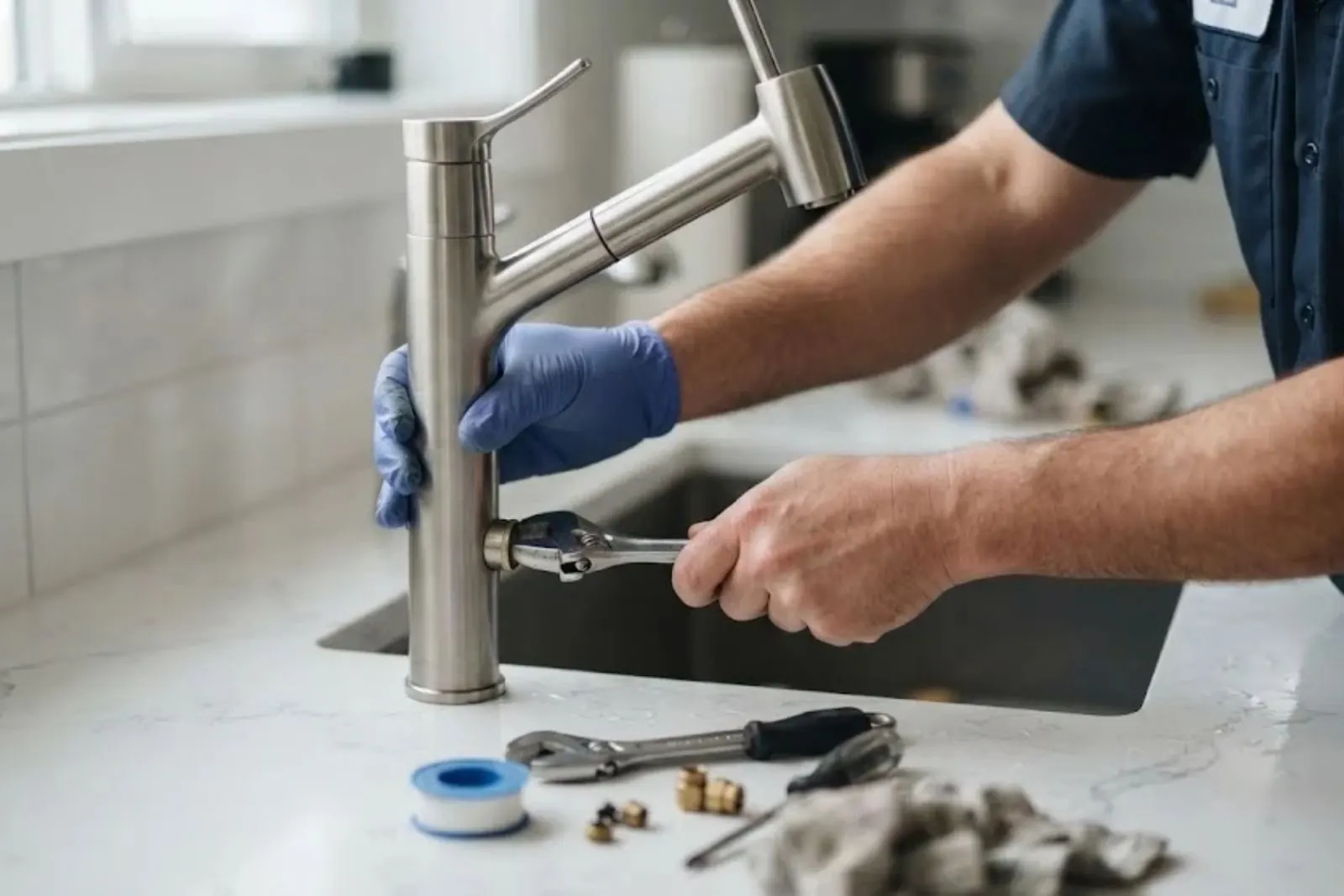
The short answer: repair first, replace when the body gives out
Most sink faucet problems start in a small internal part, so repair is the right first move. A drip from the spout points to a worn cartridge, washer, or valve seat. A weak or sideways spray points to a clogged aerator.
Replace the whole faucet when the body is cracked or pitted, the finish is flaking, or the same drip returns after a fresh cartridge. Age alone is not the test. A fifteen-year-old faucet that runs smoothly can keep going, and a newer one packed with mineral scale can fail early.
The table below turns that into a two-minute check. Read across from what you see to the usual call.
Fix-or-replace table for a kitchen or bathroom sink
| What you see | Likely cause | Usual call | Who does it |
|---|---|---|---|
| Drip from the spout with the handle off | Worn cartridge, washer, or valve seat | Repair | DIY if the shutoff valves under the sink close fully. |
| Water pooling at the base of a swivel spout | Worn O-rings | Repair | DIY. |
| Weak, split, or sideways spray | Clogged aerator | Clean the aerator | DIY. |
| Handle feels gritty or stiff | Mineral buildup inside the cartridge | Clean or replace the cartridge | DIY or plumber. |
| Wet cabinet floor under the sink | Loose supply line, or a cracked body | Tighten or replace the line, then inspect the body | Plumber if it keeps coming back. |
| Pitted, corroded, or flaking body | Fixture is wearing out | Replace | Plumber if the old connections are stuck. |
| Same drip within weeks of a new cartridge | Damaged seat or body | Replace | Plumber. |
Faucet still leaking after you tried the basics?
Call (855) 575-2890 and describe where the water shows up.
Five checks before you take anything apart
- Unscrew the aerator at the spout tip and look for gray or white grit. Soak it in vinegar and rinse.
- Dry the cabinet under the sink, then lay a dry paper towel on the supply lines to see which joint is wet.
- Close both shutoff valves under the sink and open the faucet. If water keeps running, a valve is not sealing.
- Read the brand and model stamped on the body or the underside. Parts are matched by model.
- Photograph each step as you disassemble, so you can rebuild it in order.
These five checks cost nothing and rule out the two most common false alarms, a dirty aerator and a leaking supply line.
Why a repair sometimes does not hold
A new cartridge in a pitted valve seat will leak again. So will a new washer on a seat that has been scoured by grit. Mineral scale does the same job as sand, and it wears the sealing surfaces little by little. Where the water is very hard, a water softener protects every fixture in the house.
Water pressure is the other quiet cause. Pressure that runs high pushes harder on every seal, so rubber parts flatten and harden sooner. If you have replaced the same part twice, stop swapping parts and have the pressure and the seat checked.
There is also a plain parts problem. Cartridges for discontinued models can be hard to find. That is the most honest reason to replace a faucet that still looks fine.
Stop and call a licensed plumber if
- A shutoff valve will not turn, or it keeps dripping after you close it. Forcing it can snap the stem.
- The supply connections are corroded and crumble when you touch them.
- Water is soaking the cabinet and you cannot tell where it starts.
- The pipe twists in the wall when you turn a wrench. Older lines can crack at the joint.
- The faucet is spraying and no valve will stop it. Shut the main water valve and call.
A repair that turns into a flooded cabinet costs more in damage than the call would have. When you want it handled, our faucet repair visits start with a clear price before work starts, and the 24/7 line covers a spraying fixture at night.
What a plumber looks at that a homeowner usually skips
A licensed plumber checks the whole run, not only the handle. That means both shutoff valves, the supply lines, the drain trap under the basin, and the pressure at the fixture.
The visit often ends with one of two outcomes. Either the cartridge or seat is replaced and the old fixture keeps going, or the plumber explains why the body is done and what a clean swap involves. Either way you hear the reason, which is the part a parts-store box never tells you.
If the fixture sits above a disposal, the same visit can also look at the drain side, since a leak there is easy to mistake for a faucet leak. Crews serve homes in Perry, about 4 miles south, and in Willard, about 7 miles south.
Quick rules for choosing a replacement
Match the holes
Count the holes in the sink or counter. A one-hole, three-hole, or widespread fixture has to fit what is already cut.
Choose a solid body
Brass bodies tend to age better than thin plated ones. Ask what the cartridge is, and whether it is sold on its own.
Plan for cleaning
Pick a spout with an aerator you can unscrew by hand. In hard water you will be cleaning it.
Brigham City note: 17 to 20 grains per gallon at your faucet
The Brigham City Water Division page lists water hardness at 17 to 20 grains per gallon. On the USGS scale, anything above 10.5 counts as very hard. At that level scale collects in aerators and cartridges, so cleaning the aerator first is a sound habit here, and a gritty handle often means mineral buildup rather than a failed faucet.
The city also offers water pressure testing through Public Works. If new cartridges keep failing, ask for a test, because high pressure wears seals faster. If scale keeps coming back, treating the water upstream is the lasting fix. Ask Public Works for the current hardness figure first.
Source type: City water page (hardness and pressure testing) and the USGS hardness scale
Frequently Asked Questions
It can. The city lists hardness at 17 to 20 grains per gallon, and scale builds up in aerators and cartridges, which makes handles stiff and sprays weak. Regular aerator cleaning helps, and a softener helps more. Ask Public Works for the current figure.
Often yes. Shut off the supply valves, remove the handle and retaining nut, pull the old cartridge, and match it by model. If the seat inside the body is pitted, the new cartridge will drip, and replacing the faucet makes more sense.
Dry everything, then run the faucet with the drain plugged and watch the supply lines first. Then fill the basin and let it empty while you watch the trap. A leak that appears only when water drains is on the drain side.
A slow drip can wait for a daytime visit. Water that sprays, soaks a cabinet, or cannot be shut off is urgent. Close the main valve and call the 24/7 line.
Follow the maker's directions for your model. Many supply connections seal with a rubber washer, and extra tape or sealant can keep them from seating. When in doubt, ask a licensed plumber before you tighten further.
Sources and standards
- Plumbing codes in the UPC and IPC families set the rules for fixtures, venting and drains. Ask the Brigham City building office at (435) 734-6604 which edition and permit rules apply to your job.
- The Utah Division of Professional Licensing offers a public Verify a License tool for checking any plumber's license class.
- The Brigham City Water Division explains hardness, pressure testing and water quality on its water page. Call Public Works at (435) 734-6615 with questions.
Written by Brigham City Pro Plumbing. Last updated October 29, 2026.