
The number, and what it means in plain terms
The Brigham City Water Division, which runs through Public Works, states on its water page: Water Hardness in Brigham City: 17 to 20 grains per gallon. Grains per gallon measures dissolved calcium and magnesium. More grains means more mineral coming out of every tap.
On the USGS scale, anything over 10.5 grains per gallon counts as very hard. At 17 to 20 you are well past that line, so this is not a borderline case. Your water heater works against that mineral every time it heats a tank of water.
In short, expect scale inside the heater, plan for it, and ask Public Works for the current figure, since utilities update their reports.
Where your water falls on the scale
| Class | Grains per gallon | Roughly in mg/L |
|---|---|---|
| Soft | 0 to 3.5 | 0 to 60. |
| Moderately hard | 3.5 to 7.0 | 61 to 120. |
| Hard | 7.0 to 10.5 | 121 to 180. |
| Very hard | Over 10.5 | Over 180. |
| Brigham City page | 17 to 20 | About 290 to 340 (calculated) |
The last row is arithmetic, not a lab result: one grain per gallon is about 17.1 mg/L. Treat it as a way to compare with the scale, and use the city's own figure for decisions.
Heater popping or flow dropping?
Scale is a common culprit in very hard water.
What scale does inside a tank water heater
Heat makes dissolved minerals drop out of water. In a gas tank, that crust settles on the bottom, between the burner and the water, so the burner works longer to heat the same tank. You may notice popping or rumbling as steam forces its way through the layer.
In an electric tank, scale builds on the heating elements. A coated element runs hotter and burns out sooner. The tank bottom also collects sediment that blocks the drain valve.
The anode rod sacrifices itself to protect the tank steel, and it can be used up faster in aggressive water, so it is worth checking. When it is gone, the tank lining is next, which is why hard water shortens heater life in general.
Check the anode rod before it is spent. A rod that looks mostly bare steel wire is done. Replacing it early is far cheaper than replacing a tank that has leaked, and it is a job a plumber can do during a routine visit. Pair it with a drain-and-flush so the sediment leaves with the old rod's debris.
Clues your heater is already struggling
- Rumbling, popping, or hissing when the burner or element runs.
- Hot water that runs out sooner than it used to.
- Cloudy or gritty water from the hot tap only.
- A slow drip at the drain valve, or a drain valve that will not flow.
- A rising pattern of element failures or a pilot that keeps going out.
Cold water that looks clean and hot water that looks cloudy is a useful tell. It means the problem sits in the heater, not the supply.
What it does to tankless units and fixtures
- Tankless units collect scale on the heat exchanger and slow the flow, then trip error codes.
- Faucet aerators and shower heads clog with white crust, so flow drops.
- Cartridges and valve seats wear faster as mineral grinds inside them.
- Dishwashers and washers leave spotty glass and stiff laundry.
- Dishwashers and other appliances can show spotting and scale too.
None of this is dramatic on a single day. The damage is slow, which is why many homeowners first notice it as a bill for a failed element or a shower that feels weak.
Four ways to deal with it
Flush and inspect the tank
Draining a few gallons from the tank on a schedule your manual sets clears loose sediment. Check the anode rod when you do.
Replace the anode rod on time
A fresh rod buys the tank steel more years. Ask a plumber to check yours.
Add a softener upstream
A softener swaps hardness minerals for sodium or potassium before water reaches the heater. It protects the heater and every fixture downstream.
Descale a tankless unit
A flush with approved solution clears the exchanger. In hard water, expect to repeat it.
A water softener is the only choice on this list that treats the cause. It does not remove the need for ordinary heater upkeep, and it needs salt and a drain connection, so plan the site with a plumber.
What a softener install actually involves
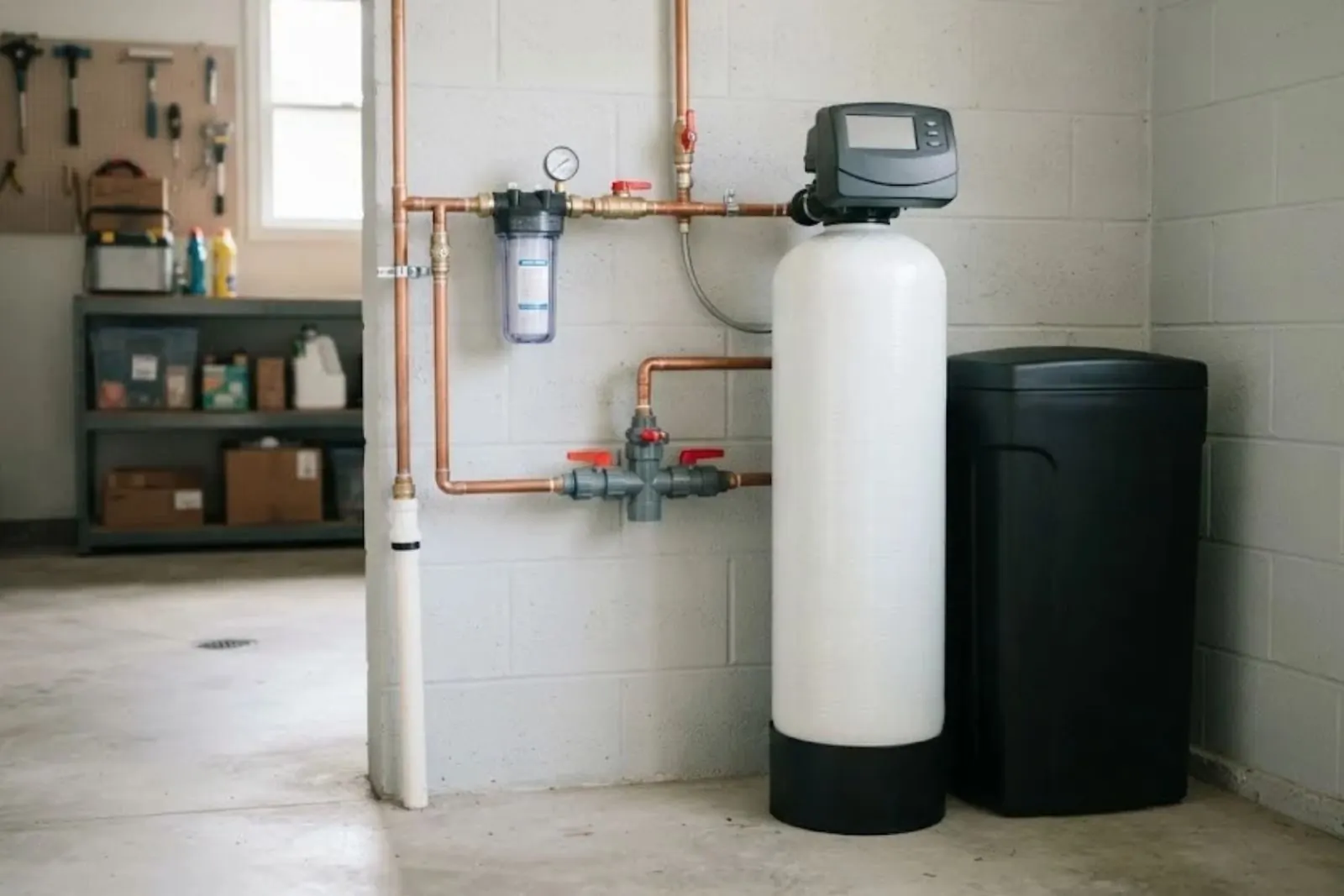
A softener sits on the main water line after the meter and before the water heater. The installer places a bypass, ties into a drain for regeneration water, and runs power for the control head. Many installs leave outdoor taps on untreated water, so ask about it.
Ask about drain placement, salt storage, and how the unit will be set for your hardness number. Ask also how the city page's range, 17 to 20, shifts the setting, since a unit programmed for the wrong figure wastes salt or leaves hardness behind.
Remember that a softener adds sodium or potassium to the water in exchange for removing hardness. People on low-sodium diets, and anyone with health concerns, should ask their doctor before choosing.
Is it time to replace the heater?
Age, leaks, and rust-colored water point toward replacement. A heater near the end of its life in very hard water is rarely worth a large repair.
If you are weighing it, a plan for water heater replacement should include a softener or a sediment-aware flush schedule so the new tank does not repeat the old one's story. Ask what is included before you compare prices.
Brigham City note: a city page that says very hard
The Brigham City Water Division's page lists hardness at 17 to 20 grains per gallon, and the 2025 Water Quality Report lists 17 sources: 8 springs and 9 wells. Because sources can differ, ask Public Works at (435) 734-6615 for the figure that applies to your address today, then size any softener to it.
Nearby towns run their own systems. Neighbors in Willard and Tremonton should ask their own city for a water quality report, since those towns' hardness is not covered here.
Source type: city water page and 2025 Water Quality Report
Frequently Asked Questions
Scale insulates the heating surface, so gas burners or electric elements work longer to reach the same temperature. The effect builds slowly.
Hardness itself is a minerals matter, not a health alarm. Questions about drinking water belong with the city's water quality report.
That depends on the maker. Read the warranty, since some set limits on water chemistry.
Ask Public Works at (435) 734-6615. The city's page lists 17 to 20 grains per gallon and the 2025 water quality report covers 17 sources, 8 springs and 9 wells, so the figure can vary with the mix.
Many manuals recommend it. In very hard water, check the manual's schedule and consider doing it more often.
Sources and standards
- Plumbing codes in the UPC and IPC families set the rules for fixtures, venting and drains. Ask the Brigham City building office at (435) 734-6604 which edition and permit rules apply to your job.
- The Utah Division of Professional Licensing offers a public Verify a License tool for checking any plumber's license class.
- The Brigham City Water Division explains hardness, pressure testing and water quality on its water page. Call Public Works at (435) 734-6615 with questions.
- Enbridge Gas Utah says to leave the building first if you smell gas, then call 911 or its 24-hour emergency line from outside.
Written by Brigham City Pro Plumbing. Last updated October 29, 2026.