
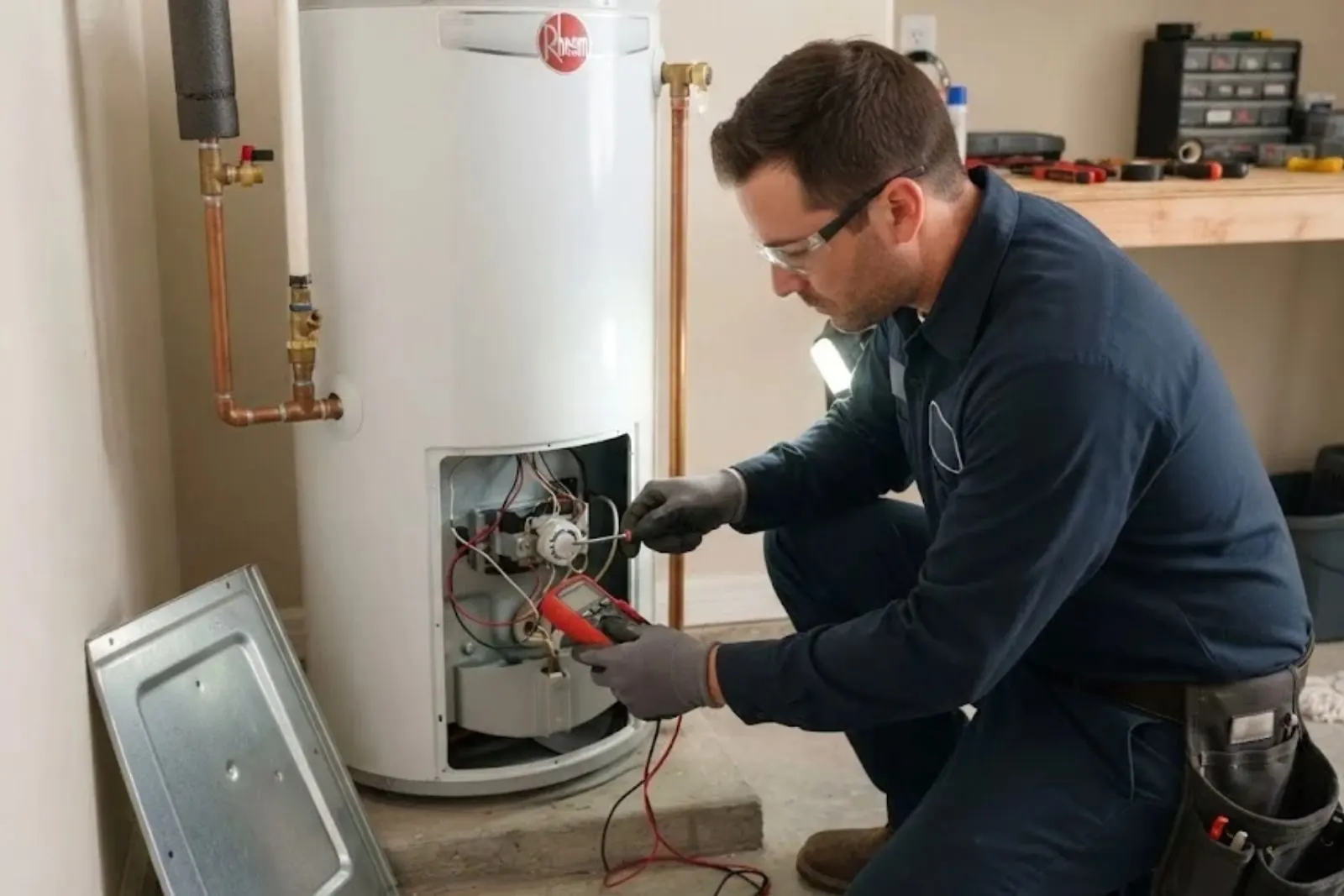
Gas smell first: leave, then call
If you smell gas, hear hissing near the heater, or a carbon monoxide alarm is sounding, leave the building immediately. Do not flip switches, use a phone, or try to find the leak. Once you are safely outside and away, call 911 or your gas utility's 24-hour emergency line.
Enbridge Gas Utah lists its emergency line as 1-800-767-1689. Do not go back in to relight a pilot or shut a valve. Wait outside until responders say the house is clear. Repairs come after the all-clear.
With no gas smell, a homeowner can safely read the temperature setting, confirm the gas valve handle is open, and look for water around the tank. Anything that involves the burner, the gas control, or the vent belongs to a licensed plumber. The rest of this guide sorts out which is which.
A traffic-light guide to gas water heater problems
| Signal | What you notice | What to do |
|---|---|---|
| Red: leave now | Rotten-egg smell, hissing near the heater, carbon monoxide alarm | Leave, then call 911 or the gas utility. |
| Red: stop use | Scorching on the draft hood, soot, or yellow flames instead of steady blue | Turn off the heater at the control, and call a licensed plumber. |
| Yellow: call a plumber | Pilot will not stay lit after one careful try, rumbling or popping, water around the base | Do not keep retrying. Schedule a repair. |
| Green: safe to check | Thermostat setting, gas valve handle position, a dirty burner-area vent screen if the maker allows it | Check, record what you find, and call if unsure. |
| Green: safe to note | Hot water runs out sooner than it used to | Note how long it lasts, then book a check. A flush may help. |
No hot water and no gas smell?
Call (855) 575-2890 and describe the pilot, the sounds, and the setting.
The checks a homeowner can do without opening the unit
- Read the temperature setting on the control. Many homes use a setting near 120 F, and a dial pushed to the lowest or vacation setting can explain a cold shower.
- Check that the gas shutoff valve at the heater is open. The handle should line up with the pipe.
- Look at the pilot window if the heater has one, but only if there is no gas smell.
- Read the label. It gives the maker's lighting instructions, and you should follow those exactly.
- Look for puddles, rust streaks, or a wet floor under the tank.
If the pilot is out and there is no gas smell, one relight attempt per the label is reasonable. If it will not stay lit, stop. The part that holds the flame is a safety device, and a plumber should replace it.
Why a gas heater rumbles, pops, or runs out early
Minerals settle at the bottom of the tank and bake into a layer that the burner has to heat through. That causes popping, rumbling, and slower recovery. It also overheats the steel under the burner.
Hard water makes this worse. Flushing the tank can help, but it is not a casual task. Hot water can scald, the gas control must be set first, and a drain valve clogged with scale can snap if forced. Call a plumber if the valve will not flow.
Signs it is time to call a licensed plumber
- The pilot goes out repeatedly, or the burner flame looks lazy and yellow.
- The temperature and pressure relief valve drips or discharges. Never cap it.
- Water pools around the base, or the tank shows rust at the seams.
- The flue pipe is loose, disconnected, or stained near the joints.
- The heater is far past the age where tanks tend to fail, and repairs keep stacking up.
Our gas water heater repair service covers the burner, control, and venting checks. If the tank itself has failed, a replacement is the honest answer, and you hear the reasoning first.
Repair or replace: a quick way to decide
Parts like a thermocouple or a gas control are repairable. A tank that leaks through the steel is finished, because water has found a way out.
Repair makes sense when the tank is sound and the problem is a single part. Replace when the tank leaks, when rust shows at the seams, or when the same heater has needed repeated work. Ask the plumber to show you the failed part, so you can see why.
What to do while you wait for a plumber
- Check for gas
If you smell gas at any point, leave and call 911 or the gas utility.
- Close the cold supply
If the tank is leaking, shut the cold water valve on top of the heater.
- Turn the control off
Set the gas control to the off position if it is safe to reach and there is no gas smell.
- Protect the floor
Lay down towels and move stored items out of the way.
- Keep notes
Write down the model and the symptoms for dispatch. Crews reach Perry and Tremonton as well as Brigham City.
Brigham City note: gas safety and hard water scale
Enbridge Gas Utah's safety guidance is the same everywhere in town: if you smell gas, leave immediately, and call once you are safely away. Memorize the steps now. Keep the utility number somewhere you can reach from outside.
The Brigham City Water Division lists hardness at 17 to 20 grains per gallon, which is very hard by the USGS scale. Scale builds on tank bottoms and heating surfaces, which shortens heater life. The city also publishes guidance on thermal expansion in water heating systems, so ask Public Works before you add an expansion tank.
Source type: Gas utility safety page and the city water page
Frequently Asked Questions
If there is no gas smell, one relight attempt following the label is reasonable. If the pilot will not stay lit, or you smell gas at any point, stop. Leave first, then call 911 or the gas utility.
Gas utilities add an odor so leaks are noticed. That smell means leave the house. Call 911 or Enbridge's emergency line from a safe distance. If the smell clears and you are not sure why, still have the heater checked.
It can. At 17 to 20 grains per gallon, sediment collects on the tank bottom and shortens tank life. Ask Public Works for the current figure and consider treatment upstream.
Only if you are confident. Set the gas control, let the water cool, and use a hose to a safe drain. A stuck or clogged drain valve is the sign to call.
A licensed plumber looks at the gas supply, the burner flame, the pilot and its safety device, the vent, and the relief valve. The tank, the anode condition where visible, and any water around the base are checked too. You get the findings explained before any repair is quoted.
Permit rules vary, so ask the Brigham City building office at (435) 734-6604 before you start. A licensed plumber can tell you what a job like yours requires.
Sources and standards
- Plumbing codes in the UPC and IPC families set the rules for fixtures, venting and drains. Ask the Brigham City building office at (435) 734-6604 which edition and permit rules apply to your job.
- The Utah Division of Professional Licensing offers a public Verify a License tool for checking any plumber's license class.
- The Brigham City Water Division explains hardness, pressure testing and water quality on its water page. Call Public Works at (435) 734-6615 with questions.
- Enbridge Gas Utah says to leave the building first if you smell gas, then call 911 or its 24-hour emergency line from outside.
Written by Brigham City Pro Plumbing. Last updated October 29, 2026.