
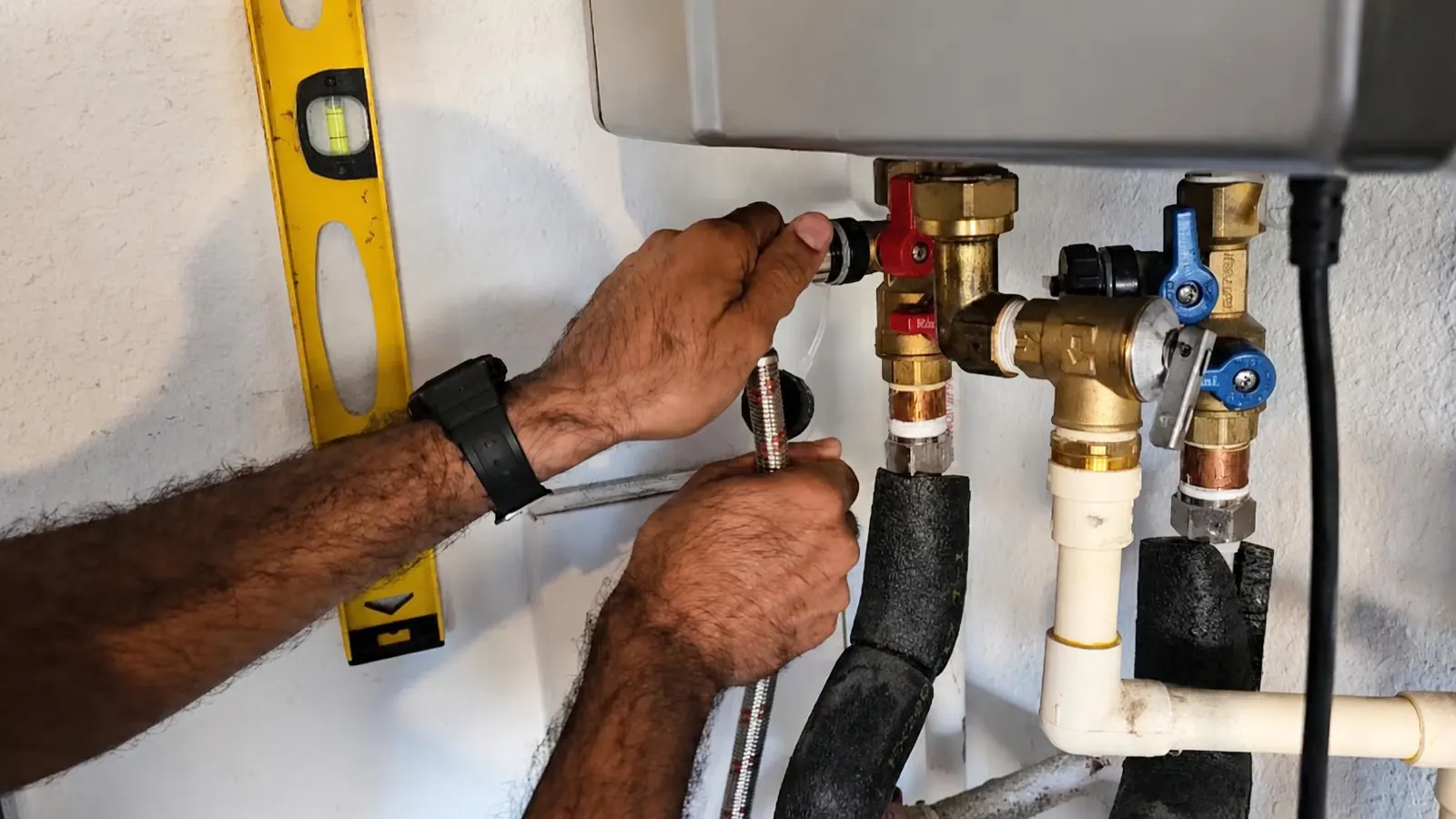
The short answer before you pick up a hose
A tankless unit has no big tank to empty. What people call draining is a flush: you run a descaling liquid, usually white vinegar or a product your manual approves, through the heat exchanger in a closed loop. That dissolves the mineral crust that builds on the metal and chokes flow.
Yes, you can do it yourself if the unit already has two service valves on the water lines. If it does not, a plumber needs to add them first, because forcing a flush without isolation valves means cutting into live pipe.
Brigham City's own water page reports hardness in the high teens of grains per gallon. That is a lot of dissolved mineral for a heat exchanger to cope with, so expect to flush on the short end of whatever interval your manual gives.
Parts and supplies to gather first
| Item | What it does | Watch for |
|---|---|---|
| Small submersible pump | Circulates the descaling liquid through the unit | Check that its hose fittings match your valves. |
| Two washing machine style hoses | Connect the pump and a bucket to the service valves | Use clean hoses so debris stays out of the exchanger. |
| Five-gallon bucket | Holds the liquid and catches rinse water | Mark it so it never gets reused for food. |
| White vinegar or approved descaler | Dissolves scale inside the exchanger | The manual names the solution and the run time. |
| Screwdriver and towels | Pull the inlet screen and wipe up drips | A few drops are normal at every fitting. |
| Owner's manual | Lists the exact valve positions and cycle length | Models differ, so trust the manual over a video. |
Not sure your tankless unit is ready for a flush?
Talk through the model and its valves with a licensed plumber before you start.
The flush, one step at a time
- Cut the power and the gas
Unplug the unit or switch off its breaker, then close the gas shutoff. If you ever smell gas, leave the house first, then call 911 or the gas utility from a safe distance.
- Close the water and open the relief ports
Shut the cold supply and the hot outlet at the service valves. Open the small purge caps on each valve to release pressure. Expect a little hot water, so wear gloves.
- Build the loop
Connect one hose from the pump to the cold side valve and another from the hot side valve back to the bucket. Pour in the descaling liquid so the pump can circulate it.
- Run the pump
Turn the pump on and let the liquid circulate for the time your manual sets. Cloudy or tinted liquid tells you scale is coming loose.
- Rinse and clear the screen
Drain the bucket, then flush with clean water for several minutes. Pull the cold inlet filter screen, rinse off grit, and reinstall it.
- Restore everything and test
Close the purge caps, reset the valves to open, restore gas and power, and run a hot tap. Watch every fitting for drips for the first few minutes.
How often the flush should happen
Manuals usually set an interval in months, and it is written for average water. Hard supply shortens it. A simple habit works well: write the flush date on the unit with a marker, and check the inlet screen halfway to the next flush.
Watch the hot water itself. If the time it takes to reach a steady temperature grows, or the flow at a far bathroom drops while cold flow stays strong, scale is likely building. Flush early rather than waiting for an error code, because a heavily coated exchanger is harder to clear and can overheat.
Keep a short log of each flush: date, solution used, how cloudy the liquid looked, and any code that showed up. A technician will find that record useful, and it helps you spot a slow decline before the unit fails.
Signs the descaling is not enough
- Hot water cuts in and out even after a clean flush and a clean screen.
- The display keeps showing an error code that returns within days.
- The vinegar comes out of the unit with almost no color, yet flow is still weak.
- You hear popping or rumbling that did not exist before.
- The unit is old and the manual says exchanger replacement is the next step.
Any one of these points to something beyond scale, such as a failing sensor, a damaged exchanger, or a gas supply problem. A repeat flush will not fix those, and a technician with a manometer and the model's service sheet can find the cause faster.
Mistakes that turn a flush into a repair
Skipping the gas shutoff
A flush with the gas supply still open can fire the burner on a dry exchanger. Close it every time.
Using the wrong liquid
Strong acids or bleach can attack seals and metal. Stick to what the manual lists.
Forgetting the screen
A clogged inlet screen mimics scale. Clean it during every flush.
Leaving valves in the service position
If the valves are not reopened, the unit starves and trips an error. Check handle direction before you walk away.
When to hand the job to a licensed plumber
Stop if the unit has no service valves, if a fitting will not turn without force, or if you find a leak you cannot trace. Also stop if the gas line looks corroded or the vent pipe is loose.
A tankless water heater technician can add valves, flush the unit, and test the combustion setup in one visit. If the unit needs to come out entirely, a plan for water heater replacement should cover venting and gas sizing as well as the swap itself.
Brigham City note: hardness and your flush schedule
The city's Water Division lists hardness at 17 to 20 grains per gallon on its own water page. That tells you the minerals are already in the supply, so a tankless owner should treat the flush as routine upkeep, not an emergency fix.
Public Works can confirm the latest figure at (435) 734-6615. If your yearly flush brings out heavy scale, ask a plumber about a softener upstream of the heater. Neighbors in Perry and Willard run their own water systems, so ask those cities for their numbers before copying a schedule.
Source type: city water page (Brigham City Water Division through Public Works)
Frequently Asked Questions
Plan on about an hour of hands-on time including setup and cleanup. The pump run itself follows the manual's time, which varies by model.
Plain white vinegar is the usual choice and most manuals accept it. Check your manual first, since some makers name a specific product.
That depends on the maker's terms. Read the warranty section of the manual, and keep notes on the date of each flush so you can show maintenance was done.
The city's water page lists hardness in the high teens of grains per gallon, and that is hard by any common scale. Ask Public Works at (435) 734-6615 for the current figure, then use it when you set your flush schedule.
First confirm the gas valve is open, the service valves are open, and the inlet screen is seated. If the code returns, write it down and call a plumber with it.
Sources and standards
- Plumbing codes in the UPC and IPC families set the rules for fixtures, venting and drains. Ask the Brigham City building office at (435) 734-6604 which edition and permit rules apply to your job.
- The Utah Division of Professional Licensing offers a public Verify a License tool for checking any plumber's license class.
- The Brigham City Water Division explains hardness, pressure testing and water quality on its water page. Call Public Works at (435) 734-6615 with questions.
- Enbridge Gas Utah says to leave the building first if you smell gas, then call 911 or its 24-hour emergency line from outside.
Written by Brigham City Pro Plumbing. Last updated October 29, 2026.